

In the rapidly evolving landscape of 2026, the American workforce is undergoing a profound transformation. The “Skills Economy” has moved from a buzzword to a fundamental structural shift, where employers prioritize specific, verifiable competencies over traditional degree titles. Nowhere is this more evident than in the field of Geography. Once perceived as the study of physical maps and state capitals, modern Geography has reinvented itself as the high-tech backbone of urban planning, climate resilience, and global logistics.
Today’s US Geography students are no longer just scholars of the Earth; they are spatial data scientists, AI integrators, and policy advisors. With the global geospatial analytics market projected to reach $117.30 billion in 2026, the demand for “spatial literacy” has reached a fever pitch. From the tech hubs of Silicon Valley to the disaster-response centers in Florida, the ability to interpret complex locational data is the new gold standard for employability.
The Rise of the Geospatial Data Scientist
The 2026 academic year has seen a significant pivot toward interdisciplinary expertise. US universities, from UW-Madison to the University at Buffalo, have integrated machine learning and Python programming directly into their Geography curricula. This shift is driven by a stark reality: according to recent industry surveys, 72% of geography-related employers now prioritize AI and automation skills in their job listings.
As the curriculum becomes more rigorous, students are frequently tasked with navigating the intersection of physical systems and digital algorithms. This complexity has led many to seek out professional geography assignment help to master advanced Geographic Information Systems (GIS) software and spatial modeling techniques. By leveraging specialized support, students ensure that their academic output meets the high standards of the current skills economy while they focus on mastering the “Human-AI” collaboration that 2026 employers demand.
Beyond the Classroom: Trends Shaping 2026
To remain competitive, American students are focusing on three critical “skill pillars” that define the current job market:
- Spatial AI (GeoAI): Using machine learning to predict environmental shifts or urban growth. In 2026, the ability to build “agentic” AI models that can autonomously analyze satellite imagery is a top-tier skill.
- Climate Adaptation Mapping: As federal funding from acts like the American Infrastructure Renewal Act pours into sustainable projects, students are focusing on geography research topics that address coastal erosion, “food deserts,” and renewable energy grid optimization.
- Ethical Cartography: With the rise of big data, the ethics of surveillance and location privacy have become central. Students are trained to navigate the legal and moral implications of spatial tracking.
Economic Outlook and Salary Projections
The financial incentive for mastering these skills is clear. The U.S. Bureau of Labor Statistics (BLS) reports that specialized geographers and geospatial data scientists are seeing growth rates of up to 14%, significantly faster than the national average for all occupations.
| Occupation | 2026 Est. Median Pay (US) | Projected Growth (2024–2034) |
| Geospatial Data Scientist | $105,500 | 14% |
| Geographer | $97,200 | 5% |
| GIS Developer | $100,400 | 12% |
| Cartographer | $78,380 | 6% |
Data Source: BLS Occupational Outlook & Research.com 2026 Reports.
Key Takeaways for 2026 Geography Students
- Prioritize Programming: Proficiency in Python and R is no longer optional for GIS roles.
- Focus on Micro-credentials: Employers value specific certifications in Cloud GIS and Spatial AI alongside traditional degrees.
- Bridge the Gap: Use academic resources and professional research guides to stay ahead of rapidly changing curriculum standards.
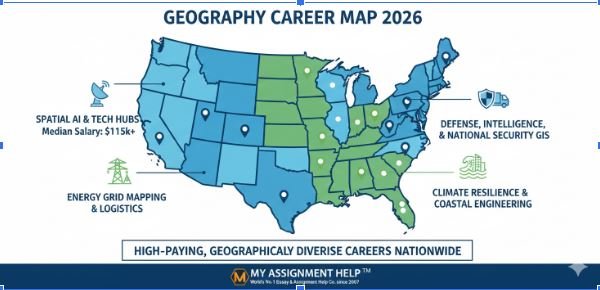
- Stay Local, Think Global: While high-demand states include California, Texas, and Virginia, remote work trends are opening geospatial roles to students across the US.
FAQ: Navigating the 2026 Geography Landscape
Q1: Is a Geography degree still relevant in the age of AI?
A: More than ever. While AI can process data, it lacks the “spatial reasoning” and cultural context that geographers provide. The role has shifted from data collection to high-level analysis and ethical oversight.
Q2: What are the most in-demand GIS software tools in 2026?
A: Industry standards remain centered on ArcGIS Pro and QGIS, but there is an increasing demand for “Cloud-Native” GIS skills, including experience with Google Earth Engine and Amazon Location Service.
Q3: How can I improve my grades in complex spatial analysis courses?
A: Successful students often utilize a mix of peer-to-peer learning, university labs, and expert consulting services. Seeking specialized help for technical assignments allows you to understand the logic behind the software rather than just following a tutorial.
Author Profile: Dr. Sarah Bennett
Senior Academic Strategist at MyAssignmentHelp
Dr. Sarah Bennett holds a Ph.D. in Human Geography and has over a decade of experience in geospatial research and academic consulting. Currently serving as a Senior Content Strategist at MyAssignmentHelp, she specializes in bridging the gap between academic theory and industry requirements. Her work focuses on empowering US students to navigate the complexities of GIS, urban planning, and environmental science in the modern digital era.
